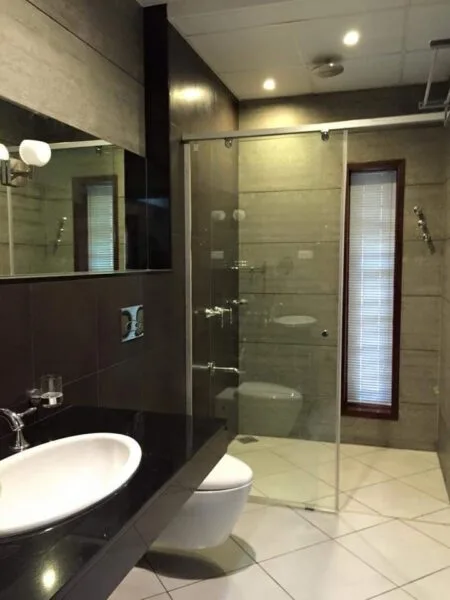
A well-designed bathroom should balance privacy, functionality, safety, and visual appeal. Bathroom glass partitions are a practical way to separate wet and dry areas while maintaining an open and contemporary look. Unlike solid walls, glass allows light to pass through, helping the bathroom feel more spacious.
In this blog, Scapes Home Essentials, the providers of bathroom glass partitions in Kerala, bring you a closer look at the different types of bathroom glass partitions, including their designs, structures, and glass finishes, to help you choose the right option based on your space.
Different types of bathroom glass partitions
Bathroom glass partitions come in different designs and configurations to suit various bathroom layouts, space requirements, and privacy preferences. From fixed and sliding partitions to frameless and half-glass options, each type offers its own combination of functionality and style. Understanding these options can help you select a partition that complements your bathroom while creating an effective separation between wet and dry areas.
Design and Structure Types
Bathroom glass partitions can be classified by how the glass panels are installed and operated. The right configuration depends largely on the available space, access requirements, and overall bathroom design.
Fixed Glass Partition
A fixed glass partition is a stationary panel that does not open or move. It is commonly used to separate the shower or wet zone from the dry area without creating a fully enclosed cubicle.
This design provides an open, minimalist appearance and allows easy access to the shower area. Since there are no moving mechanisms, it can also offer a relatively simple installation and maintenance arrangement. Fixed panels are particularly suitable for walk-in shower layouts and bathrooms where maintaining an open visual connection is important.
Sliding Glass Partition
A sliding glass partition uses one or more glass panels that move along a track instead of opening into the bathroom. Because the panels do not require a door-swing area, sliding systems can be useful in compact bathrooms where available floor space is limited.
A properly designed sliding partition can provide effective separation between wet and dry zones while keeping the bathroom layout practical. The quality and installation of the sliding hardware are important for smooth and reliable operation, particularly in a humid environment.
Hinged / Swing Partition
A hinged or swing glass partition uses a door panel attached to hinges and opens inward, outward, or in a suitable direction according to the design and hardware arrangement. It provides convenient access while giving the bathroom a more defined enclosure.
This configuration works well when there is sufficient clearance for the door to operate safely. The position of the hinges, door width, surrounding fixtures, and available circulation space should be considered before installation.
Frameless Partition
A frameless partition uses glass with minimal visible framing, relying on suitable clamps, channels, hinges, or other hardware for support. Its clean lines create a seamless and contemporary appearance.
Because there is less visual obstruction around the glass, frameless partitions can help preserve sightlines and make the bathroom appear more open. They are particularly suited to modern interiors where simplicity and transparency are important design elements.
Framed or Semi-Framed Partition
Framed and semi-framed partitions provide additional structural support around some or all of the glass panels. A framed system generally has a more visible frame, while a semi-framed design combines framed sections with areas of exposed glass.
These options can be considered when a homeowner wants a balance between the minimalist appearance of glass and the additional support provided by framing. The choice of frame material and finish can also be coordinated with other bathroom fittings to create a consistent appearance.
Half-Glass Partition
A half-glass partition covers only part of the opening or shower area rather than forming a complete enclosure. It provides a visual and physical separation while retaining a more open bathroom layout.
This design can be suitable for bathrooms where complete enclosure is unnecessary. It can also help maintain natural light and an unobstructed sense of space while providing a degree of separation between the wet and dry areas.
Glass Opacity and Finishes
The appearance and privacy level of a bathroom partition are also determined by the type of glass finish selected. Clear, frosted, tinted, and patterned options can create significantly different visual effects.
Clear Glass
Clear glass provides maximum transparency and allows light to move freely through the bathroom. It is a popular choice for contemporary bathrooms because it creates a clean and spacious appearance while keeping the shower area visually connected to the rest of the room.
Clear glass is generally best suited to bathrooms where privacy within the shower area is not a major concern. Its transparent surface also makes the bathroom’s design elements more visible, so keeping the glass clean is important for maintaining its appearance.
Frosted / Etched Glass
Frosted or etched glass reduces visibility through the panel while continuing to allow light to pass through. This makes it a useful option when privacy is more important than complete transparency.
The frosted effect can be produced through different glass-processing techniques or applied finishes. It can be used across the entire panel or incorporated selectively to create a combination of privacy and transparency. For shared bathrooms, this type of finish can provide a more comfortable level of visual privacy without replacing the glass partition with an opaque wall.
Tinted / Patterned Glass
Tinted glass introduces a subtle colour tone, while patterned glass incorporates a textured or decorative surface. Both options can be used to give the bathroom partition a stronger design character while reducing direct visibility to varying degrees, depending on the selected product.
Patterned or textured surfaces can also add visual interest to an otherwise simple glass enclosure. The specific level of privacy, light transmission, and appearance depends on the particular tint or pattern selected, so the finish should be chosen in relation to the bathroom’s lighting, colour palette, and privacy requirements.
For bathroom applications, the glass itself should be selected with safety in mind. In India, IS 2553 (Part 1): 2018 covers safety glass for architectural, building, and general uses, including toughened (tempered) and laminated safety glass. The Bureau of Indian Standards (BIS) identifies this standard under the applicable safety-glass certification framework.
Conclusion
The different types of bathroom glass partitions offer solutions for a wide range of bathroom layouts and design preferences. Fixed panels provide a simple open layout, sliding systems help save floor space, hinged partitions offer convenient access, and frameless designs create a sleek contemporary appearance. Framed, semi-framed, and half-glass options provide further flexibility depending on the required structure and visual effect.
The choice of glass finish is equally important. Clear glass maximises openness, frosted or etched glass provides greater privacy, and tinted or patterned glass can introduce a distinctive decorative element. Along with appearance, homeowners should consider safety glass specifications, hardware quality, installation requirements, and the bathroom’s overall layout.
For homeowners looking for bathroom glass partitions in Kerala, Scapes Home Essentials offers customised solutions focused on combining aesthetics, functionality, durability, and professional installation. Choosing the right partition configuration and glass finish can transform the bathroom into a more practical, comfortable, and visually refined space.