Why Handrail Standards Matter
When it comes to building safety and accessibility, railings are significantly more crucial than most people realise. From staircases and balconies to ramps and walkways, properly built railings help to minimise accidents, promote mobility, and ensure that modern construction regulations are met. Adhering to the National Building Code (NBC) 2026 is now required for getting occupancy certifications in many jurisdictions, making it critical for builders, architects, and property owners to follow approved handrail requirements during construction.
Whether for residential, commercial, or industrial projects, selecting high-quality, standards-compliant solutions is critical for safety and legal approval. This is why many property owners and developers look for the best handrails in Kerala that combine durability, aesthetics, and compliance with the latest building regulations. In this blog, we’ll cover why handrail standards are important, the main NBC 2026 requirements, and how the correct handrail system may increase both safety and design.
What is the Standard for Handrails in India?
Handrail standards in India are intended to promote safety, accessibility, and structural stability in residential, commercial, and public buildings. Handrails are no longer regarded only as a design element, but rather as a mandated safety component governed by national rules and engineering standards.
The Regulatory Framework
The primary guideline governing handrail standards in India is the National Building Code (NBC) of India, which offers detailed guidelines for secure building design, construction practices, accessibility, and fire safety. The NBC specifies the criteria for staircases, ramps, balconies, corridors, and elevated walkways where protective railings and handrails are necessary.
In addition to the NBC, IS 4912 — “Safety Requirements for Floor and Wall Openings, Railings, and Toe Boards” — is essential in specifying technical safety specifications for railings and protective barriers. This Indian Standard aims to reduce the risk of falls in residential, industrial, and commercial settings by establishing requirements for railing height, spacing, strength, and load resistance.
The NBC and IS 4912 work together to guarantee that railings offer:
- Adequate support and user safety
- Protection against accidental falls
- Accessibility for elderly individuals and persons with disabilities
- Structural integrity under pressure and heavy usage
As authorities increasingly demand compliance, adhering to these requirements has become critical for gaining permissions and occupancy certificates in numerous regions.
Height Requirements for Handrails
One of the most crucial elements of safety compliance is appropriate railing height. The criteria differ slightly according to the type of building and its intended use.
Residential Buildings
Handrails in homes, villas, and apartments are often required to be installed at a height of 900 mm to 1000 mm from the nosing (front edge) of the stair treads. This height range provides comfortable support for adults while remaining safe for youngsters and the elderly.
Residential handrails should also provide:
- Smooth and continuous gripping surfaces
- Secure anchoring to walls or staircase structures
- Minimal gaps that could pose safety risks
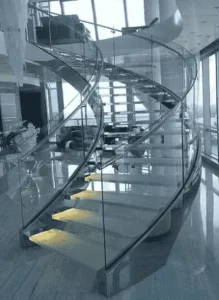
Modern homes frequently favour beautiful stainless steel, glass, or wooden designs, but looks should never outweigh compliance and longevity.
Commercial and Public Buildings
In commercial complexes, hospitals, schools, shopping malls, offices, and other public spaces, rigorous safety precautions are implemented due to higher foot traffic and greater exposure to risk. In such environments, handrail heights are usually maintained between 1000 mm and 1200 mm to offer greater safety and stability.
Public building handrails must also consider:
- Accessibility standards for differently-abled individuals
- Crowd movement and emergency evacuation safety
- Resistance to frequent usage and impact
Load-Bearing Requirements
Beyond their height and appearance, handrails must be structurally sturdy enough to bear force and pressure without failing. Handrails and railings must typically withstand a horizontal load of 0.75 kN/m, according to Indian safety requirements. This requirement ensures that the railing system is sturdy when users lean, push, or apply unexpected pressure to it.
Load-bearing compliance is especially important in:
- Multi-storey buildings
- Public infrastructure
- Industrial facilities
- Balconies and terraces
- Emergency exit staircases
Poor-quality materials or incorrect installation can cause structural failure, posing significant safety risks and legal consequences.
Specific Regulations for Handrails in Kerala
In Kerala, handrail installation is governed not just by national standards like the National Building Code (NBC) and IS 4912, but also by state-level building laws that apply to municipalities, companies, and panchayats. These local laws are meant to promote building safety, accessibility, and structural reliability while taking into account Kerala’s specific climatic circumstances.
KMBR & KPBR Guidelines
Two major regulatory frameworks oversee construction standards in Kerala:
- The Kerala Municipality Building Rules (KMBR) apply to buildings constructed within municipal and corporation limits.
- The Kerala Panchayat Building Rules (KPBR) govern construction in panchayat and rural areas.
Both KMBR and KPBR provide provisions for staircases, balconies, terraces, ramps, and fire escape systems where railings and guardrails are required. These regulations comply closely with NBC guidelines but may impose specific local standards depending on building type, occupancy, and height.
Under these rules, handrails are generally required for:
- Staircases with multiple risers
- Elevated corridors and balconies
- Roof terraces
- Ramps for accessibility
- Fire escape staircases
- Public access buildings
Authorities may evaluate these safety measures before issuing occupancy certificates, making compliance required for both residential and commercial projects.
Weather Considerations in Kerala
Kerala’s tropical climate creates additional challenges for handrail durability and maintenance. The state experiences:
- High humidity throughout the year
- Intense monsoon rainfall
- Saline coastal air in many regions
- Increased risk of corrosion and rust
These environmental factors make material quality equally crucial to dimensional conformity. Poor-quality metals corrode rapidly, weakening the structure and jeopardising safety over time.
For long-lasting performance, many builders prefer:
- Stainless steel handrails
- Powder-coated aluminium systems
- Galvanized steel structures
- Weather-resistant glass and metal combinations
Corrosion-resistant materials are highly advised to preserve both structural integrity and attractiveness, particularly in coastal areas. This is one reason why property owners frequently invest in the best handrails in Kerala, which are specifically constructed to resist the state’s harsh weather conditions.
Fire Escape Stair Regulations
Fire safety standards in Kerala place special focus on emergency exit staircases and fire escape paths. Handrails on fire escape stairs are held to higher standards since they play an important role during crises and evacuations.
Fire escape handrails are often required to have a minimum height of 100 cm (1000 mm) to give enough protection and support during high-pressure evacuations. These staircases must also guarantee:
- Strong load-bearing capacity
- Non-slip accessibility
- Continuous hand support throughout the escape route
- Durable materials capable of withstanding heavy usage
Commercial complexes, flats, hospitals, hotels, educational institutions, and high-rise buildings are typically subjected to more stringent inspections for fire escape compliance before approval is granted.
Graspability and Clearance: The Technical Details
Handrail Diameter
For a handrail to give a pleasant and stable hold, its size must be carefully considered. Circular handrails should typically have an external diameter of 32 to 50 mm, according to widely recognised standards.
This diameter range allows users to:
- Firmly wrap their fingers around the rail
- Maintain better balance while climbing or descending stairs
- Reduce hand fatigue during prolonged use
- Improve support during emergencies or sudden slips
If the handrail is too large, users may struggle to grip it securely. If it is too little, it may not offer enough stability. Therefore, railings that are the right size are crucial for both comfort and security.
In commercial structures, hospitals, schools, and senior-friendly spaces, ergonomic handrail design becomes even more crucial because of the elevated safety standards and accessibility standards.
Wall Clearance Requirements
Another essential component of handrail safety is the spacing between the handrail and the wall. In general, standards require a 50 mm free gap between the wall surface and the inside edge of the handrail.
This clearance is necessary to:
- Allow users to fully wrap their hands around the rail
- Prevent fingers from getting trapped or pinched
- Ensure smooth hand movement along the staircase
- Improve accessibility for all users
Insufficient wall clearance might make the handrail uncomfortable or challenging to use, which lessens its usefulness in emergencies or for people who need extra assistance.
In order to maintain this necessary space while guaranteeing structural integrity, proper installation of brackets and mounting systems is crucial.
Continuity of Handrails
Handrails should ideally be continuous along the flight of stairs, with no interruptions that could compromise the user’s hold. Continuous handrails assist people in retaining their balance from the start to the finish of the staircase, considerably boosting safety.
In many standard guidelines, handrails are also recommended to:
- Extend at least 300 mm beyond the top and bottom steps
- Follow the slope of the staircase smoothly
- Avoid sharp edges or abrupt terminations
These additions give additional support when users start ascending or finish descending stairs, which are frequently the areas where slips and balance loss occur.
Continuous handrails are particularly important in:
- Hospitals and healthcare facilities
- Educational institutions
- Commercial complexes
- Public buildings
- Senior-friendly residential projects
Common Compliance Mistakes to Avoid
Incorrect Baluster Spacing
One of the most common safety concerns is excessive spacing between balusters or vertical pickets. Building codes normally demand that the spacing between balusters be less than 100 mm to prevent little children from slipping through or becoming caught between the rails.
Proper baluster spacing is especially important in:
- Residential balconies
- Staircase railings
- Terrace safety barriers
- Apartment corridors
- Public buildings and schools
Ignoring this rule can greatly increase fall risks, especially for children. Wide gaps also reduce the overall protective effect of the railing system.
Sharp Edges and Unsafe Endings
Handrails should never terminate abruptly with exposed sharp edges or projections. Poorly finished ends can:
- Snag clothing or bags
- Cause cuts and impact injuries
- Increase accident risks during emergency movement
To comply with safety standards, handrail ends should ideally:
- Turn back smoothly into the wall
- Terminate into a rounded post
- Avoid protruding edges or corners
Smooth and properly finished terminations improve both user safety and the overall appearance of the staircase design.
Inadequate Anchoring and Weak Fasteners
The strength of a handrail depends on its anchoring system. Using subpar brackets, screws, or fasteners that loosen over time as a result of frequent use, vibration, or exposure to the environment is one of the riskiest errors.
Weak anchoring can result in:
- Wobbling handrails
- Structural instability
- Sudden railing failure under pressure
- Increased maintenance costs
This problem becomes even more critical in Kerala’s humid and monsoon-prone climate, where corrosion may quickly damage inferior materials and fittings. Stainless steel anchors, corrosion-resistant brackets, and high-quality mounting solutions are strongly advised for long-term durability and safety.
Proper anchoring is especially critical for:
- Fire escape staircases
- Commercial buildings
- Hospitals and schools
- High-rise apartments
- Outdoor staircases and balconies
Conclusion
Handrail standards in India are more than just technical instructions; they are critical safety regulations that protect individuals in residential, commercial, and public buildings. From correct height and load-bearing capacity to graspability, baluster spacing, and fire escape compliance, every detail plays an important part in developing secure and accessible environments. With standards such as the National Building Code (NBC), IS 4912, KMBR, and KPBR becoming more relevant for permits and occupancy certificates, guaranteeing compliance is no longer an option.
In a state like Kerala, where the weather can affect the lifetime of construction materials, selecting high-quality, corrosion-resistant railing systems is critical. Investing in expertly developed and standards-compliant solutions not only enhances safety and durability but also boosts the overall look and value of a property. Property owners and builders can achieve the ideal blend of safety, functionality, compliance, and contemporary design by choosing Scapes Home Essentials, the best company for handrails in Kerala.