Balcony railings are more than just architectural features. They play an essential role in ensuring safety while enhancing the overall appearance of your home. Among the various railing materials available today, glass has become a popular choice for modern homes, apartments, and commercial buildings. It offers an elegant, open look without compromising the functionality of a traditional railing.
However, when choosing glass for your balcony railing, one important decision is whether to go with tempered glass or laminated glass. Both options are designed to offer strength and safety, but they differ significantly in their structure, breakage behaviour, durability, and level of protection.
In this blog, Scapes Home Essentials, a provider of quality glass handrails in Kerala, explores the key differences between tempered and laminated glass, their safety features, breakage behaviour, and suitability for balcony railings to help you understand which option is right for your space.
What is Tempered Glass?
Tempered glass, also known as toughened glass, is a type of safety glass manufactured through a specialised heating and rapid cooling process. This treatment makes it significantly stronger than ordinary annealed glass and improves its resistance to impact, mechanical loads, and thermal stress.
It is widely used in modern architectural applications, including balcony railings, doors, windows, shower enclosures, and glass partitions.
Let’s look at its important characteristics.
1. Structure
Tempered glass is made from a single sheet of glass that undergoes a controlled heat-treatment process. It is heated to a high temperature and then rapidly cooled using air jets. This process creates compressive stress on the surface and tensile stress inside the glass, making it much stronger than standard annealed glass.
2. Breakage Behaviour
One of the biggest safety advantages of tempered glass is how it breaks. Instead of forming large, sharp shards like ordinary glass, it breaks into numerous small, relatively blunt fragments.
This significantly reduces the risk of severe cuts and injuries. However, once tempered glass breaks, the entire panel may lose its structural integrity, and the fragments can fall out of the railing frame. This is an important consideration when using it for elevated balconies.
3. Best Used For
Tempered glass is suitable for applications where strength, impact resistance, and a clean appearance are important.
Some common applications include:
- Framed glass balcony railings with appropriate structural support.
- Glass doors and windows.
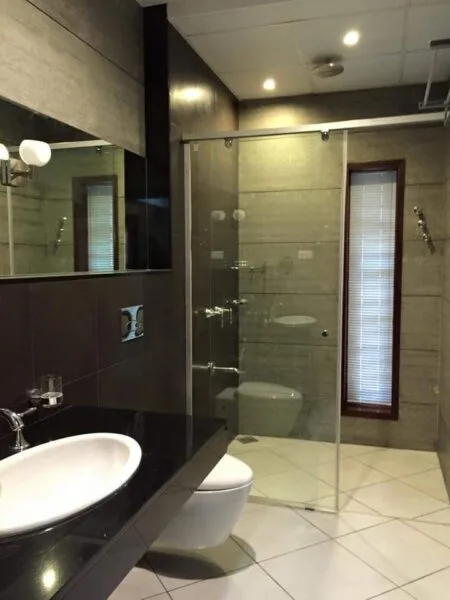
- Shower enclosures and bathroom partitions.
- Interior glass partitions.
- Staircase glass panels with suitable support systems.
4. Bonus Features
Apart from its strength, tempered glass offers several additional advantages:
- Thermal-stress resistance: It can withstand greater temperature differences than ordinary annealed glass.
- Impact resistance: It offers better resistance to everyday knocks and accidental impacts.
- Low maintenance: Its smooth surface is easy to clean and maintain.
- Modern appearance: It provides a clear, minimalist finish that complements contemporary architecture.
5. Cost
Tempered glass is generally more affordable than laminated glass of comparable specifications. Its manufacturing process is relatively straightforward, making it a cost-effective choice for several architectural applications.
However, the overall installation cost depends on glass thickness, panel dimensions, hardware, support systems, and customisation requirements.
What is Laminated Glass?
Laminated glass is another type of safety glass that is specifically designed to hold together when broken. It is manufactured by bonding two or more layers of glass using a strong interlayer, commonly made from Polyvinyl Butyral (PVB) or an ionoplast interlayer such as SentryGlas.
The interlayer acts as a bonding material that holds the broken glass fragments together, preventing them from easily falling apart.
Because of this unique feature, laminated glass is widely preferred for applications where retaining the glass panel after breakage is essential, particularly in balcony railings and other elevated structures.
Let’s understand its key characteristics.
1. Structure
Laminated glass consists of two or more sheets of glass bonded together with a transparent polymer interlayer. The layers are combined under controlled heat and pressure to create a single composite panel.
Depending on the application, laminated glass can be manufactured using annealed, heat-strengthened, or fully tempered glass plies.
This construction provides additional protection because the interlayer helps hold the glass together even if one or both glass layers break.
2. Breakage Behaviour
The most important advantage of laminated glass is its post-breakage behaviour.
When laminated glass breaks, the glass fragments generally remain attached to the interlayer instead of falling away immediately. This helps the panel retain its position and reduces the risk of broken glass falling onto people or property below.
For balcony railings, this behaviour can help keep the broken panel within the railing system and reduce the risk of glass falling onto people or property below. However, fragment retention does not guarantee that the damaged panel will remain securely in place or continue functioning as a safe barrier. This depends on the glass construction, interlayer, support system, and extent of damage.
A broken laminated panel should never be considered safe for continued use without professional assessment and replacement.
3. Best Used For
Laminated glass is particularly suitable for applications where safety and post-breakage protection are priorities.
Common applications include:
- Frameless glass balcony railings.
- Glass balustrades for elevated spaces.
- Staircase glass railings.
- Glass barriers in commercial buildings.
- Skylights and overhead glazing.
- Glass partitions where additional safety is required.
4. Bonus Features
Laminated glass offers several benefits beyond its ability to hold broken fragments together.
- Enhanced safety: Its interlayer helps prevent broken glass from falling out of the panel.
- Sound insulation: Depending on the glass and interlayer specifications, it can help reduce noise transmission.
- UV protection: Certain interlayers help filter ultraviolet radiation, protecting interior furnishings from fading.
- Design flexibility: It is available in different colours, finishes, thicknesses, and transparency levels.
- Additional security: Depending on the glass construction and interlayer specifications, laminated glass can make penetration more difficult and time-consuming.
5. Cost
Laminated glass generally costs more than standard tempered glass because it requires multiple glass layers and an additional bonding process.
The final price depends on the number of glass layers, thickness, interlayer material, finish, and installation requirements.
Although the initial investment may be higher, its ability to retain broken fragments makes it a worthwhile consideration for safety-critical applications such as balcony railings.
Tempered vs. Laminated Glass: Which is Safer for Your Balcony Railing?
Now that we understand both glass types, let’s look at which one is better suited for balcony railings. The main difference lies in their structure and breakage behaviour. Tempered glass is a single heat-treated sheet that offers high impact resistance and breaks into small, relatively blunt fragments. However, once broken, it may lose its structural integrity and leave an opening in the railing.
Laminated glass, on the other hand, consists of two or more glass layers bonded together with an interlayer that holds the fragments in place when broken. While its strength depends on its construction, it offers better post-breakage protection and can also provide improved sound insulation. It generally costs more than tempered glass. For balcony railings, particularly frameless designs, properly specified laminated safety glass is generally the preferred choice when fragment retention is a priority. However, both options require appropriate structural support and professional installation.
Is Toughened Laminated Glass an Even Better Option?
Toughened laminated glass can be a suitable option for balcony railings where both strength and post-breakage protection are important. It consists of two or more tempered glass layers bonded together using a specialised interlayer. While the tempered layers provide increased mechanical strength and impact resistance, the interlayer helps hold the broken fragments together if the glass breaks.
This combination makes it particularly suitable for frameless balcony railings, provided the appropriate interlayer, glass thickness, support system, and fixing methods are selected to meet the required structural loads and ensure the intended post-breakage performance.
Ultimately, the safest choice is not simply the strongest glass but a complete railing system designed to provide reliable protection through proper material selection, structural support, and professional installation.
Conclusion
Tempered and laminated glass differ mainly in their structure, strength, and breakage behaviour. While tempered glass offers high impact resistance and breaks into small fragments, laminated glass holds broken pieces together through its interlayer, providing better post-breakage protection. For balcony railings, toughened laminated glass can offer the combined benefits of strength and fragment retention, making it a suitable option when properly designed and installed.
Looking for high-quality glass handrails in Kerala? Scapes Home Essentials offers quality handrail products along with professional installation services to complement your home’s safety and aesthetics. Connect with Scapes Home Essentials to explore modern railing solutions for your space.